Late Summer Spritz
Apparatus 22 | Diana Cepleanu | Roberta Curcă | Adelina Ivan | Gili Mocanu | Giuliano Nardin | Marusa Sagadin| Kristin Wenzel | Madalina Zaharia
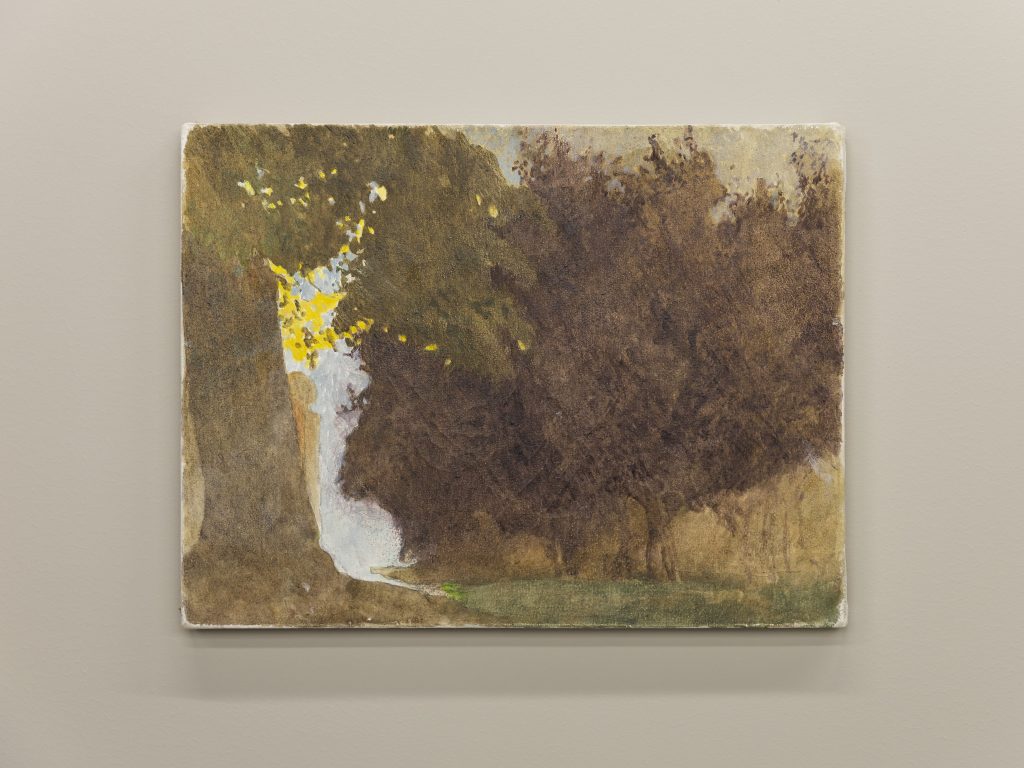
MARe / Museum of Recent Art is expanding its vision of the art scene by inviting an artist whose works are part of the collection to curate an exhibition. For this first iteration, artist Larisa Sitar steps into the role of curator, gathering contemporary works by artists based in or connected to Bucharest for the group exhibition Late Summer Spritz.
This show brings together 9 artists who share a distinct affinity for abstract, near-non-representational imagery. Through a subtle interplay of shape, color, and materiality, the works evoke the atmosphere of a torrid city deserted by its inhabitants escaping the summer heat. In this collective human absence, an uncanny otherness emerges, stepping out of the background to let raw surfaces and objects claim center stage. This excess of information—and noise— that urban environment produces simply by existing, has been filtered and synthesized into new, unexpected objects. Taken out of their initial context and reframed, they acquire a sculptural dimension that was previously unnoticed due to overfamiliarity. The techniques deployed across the exhibition are deliberately heterogeneous, yielding a rich variation in texture, gesture, and tonality — a plurality of approaches that mirrors the city’s own layered, non-hierarchical accumulation of surfaces.
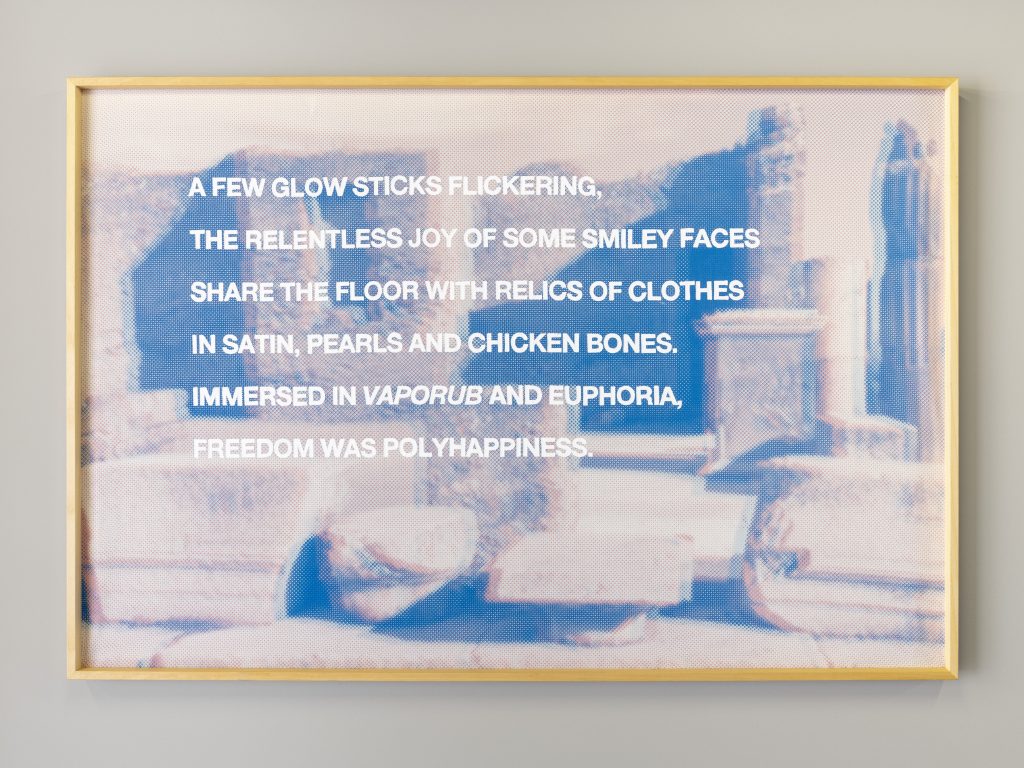
Apparatus 22 is a collective of daydreamers, citizens of many realms, researchers, poetic activists, and (failed) futurologists, founded in Bucharest in January 2011 by Erika Olea, Maria Farcaș, and Dragoș Olea, together with Ioana Nemeș (1979–2011). Since 2015 the group has worked between Bucharest, Brussels, and the utopian universe of SUPRAINFINIT. Their series ABOVE AND BEYOND stages speculative still lifes — the codes and conventions of the historical still-life genre overturned, allowing language and the viewer’s imagination to “paint” poetic compositions open to infinite interpretation — around moments, across contexts (Iran, Romania, the underground clubbing scenes of New York and London), when clubbing embodied an impromptu socio-political agenda in opposition to prevailing, oppressive perspectives. Clubbing, in this reading, was never only ecstasy — it was also a safe space for freedom.
Diana Cepleanu (b. 1957) navigates the tension between a love of abstraction and the seduction of figuration — a seduction she is wary of, precisely because it charms others so easily. As if in defense, she corrodes and dismantles portraits and recognizable objects, foregrounding the textured, sensorial surface of the painting instead, into which she folds a sense of time, of the lived moment. Working with an apparent effortlessness, and through a sort of economy of means, she manages to capture something beyond likeness — a kind of essence.
Roberta Curcă (b. 1991) researches the use of ceramic tiles for exterior building finishes — widely deployed across the Socialist Bloc, Romania included, yet tracing back to the ceramic tiles designed by the Italian architect and designer Gio Ponti for Joo Milano in the 1950s. Her interest is neither purely aesthetic nor simply nostalgic, but an act of preservation: this architectural practice is now vulnerable to degradation and disappearance, as buildings are insulated or demolished. She collects fallen tiles and photographs the buildings that still carry them, an archive maintained on the Instagram page @tile.and.tiles. For the work shown here, she appropriates the visual language and material logic of the ceramic tile itself, playfully constructing replica-objects — a portrait, a plant, in tile.
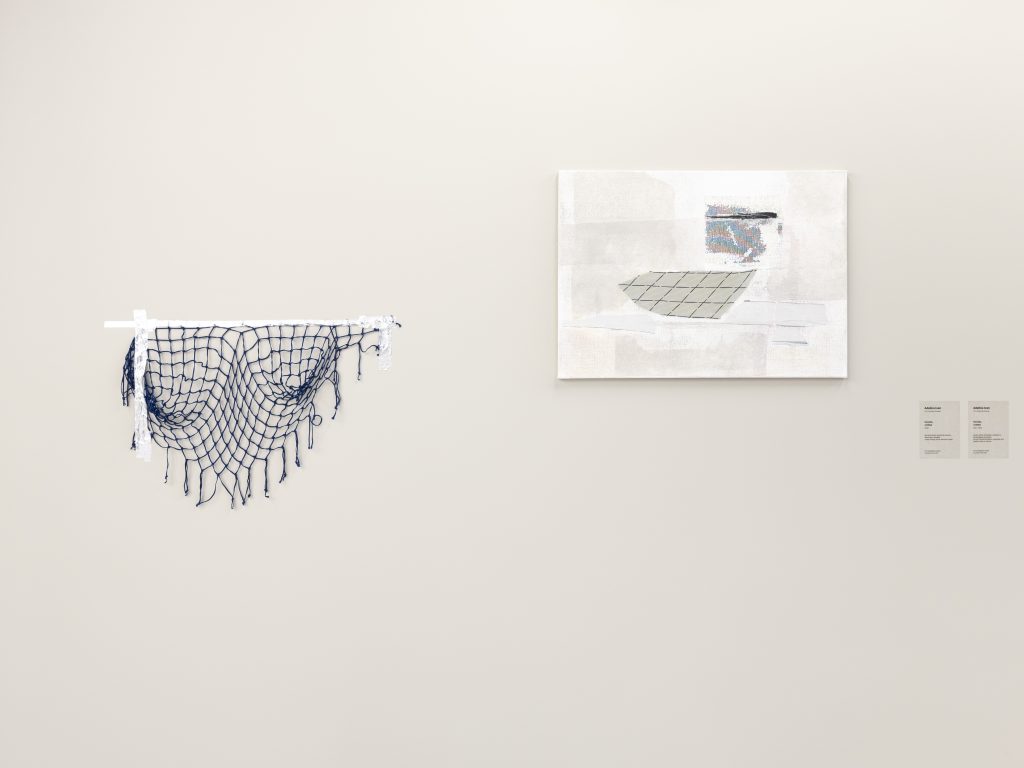
Adelina Ivan (b.1971) uses an abstract visual language of open and fluid geometries, in which textile forms merge with the painted background. She approaches textile structures as both visual and metaphorical representations of contemporary complexity, where textile form is no longer a vehicle for representation but an instrument of construction—one that privileges interconnectedness, repetition, and transformation over representation.
Gili Mocanu (b. 1971) plays with flatness and depth through color, light, and shadow, in a geometric, non-representational painting that manages to evoke, simultaneously, empty rooms, modernist abstraction, and the color-bar patterns once used to calibrate video signals. Tension and emotion are built into the surface of the work, while ample space is left for the viewer to project their own imagination onto the canvas.
Giuliano Nardin (b. 1978) approaches each work as a new experiment, without preliminary sketches or studies; he does not know in advance where a painting will take him. The result is a cast of colorful characters that read as spontaneous, cartoonish, and mysterious all at once.
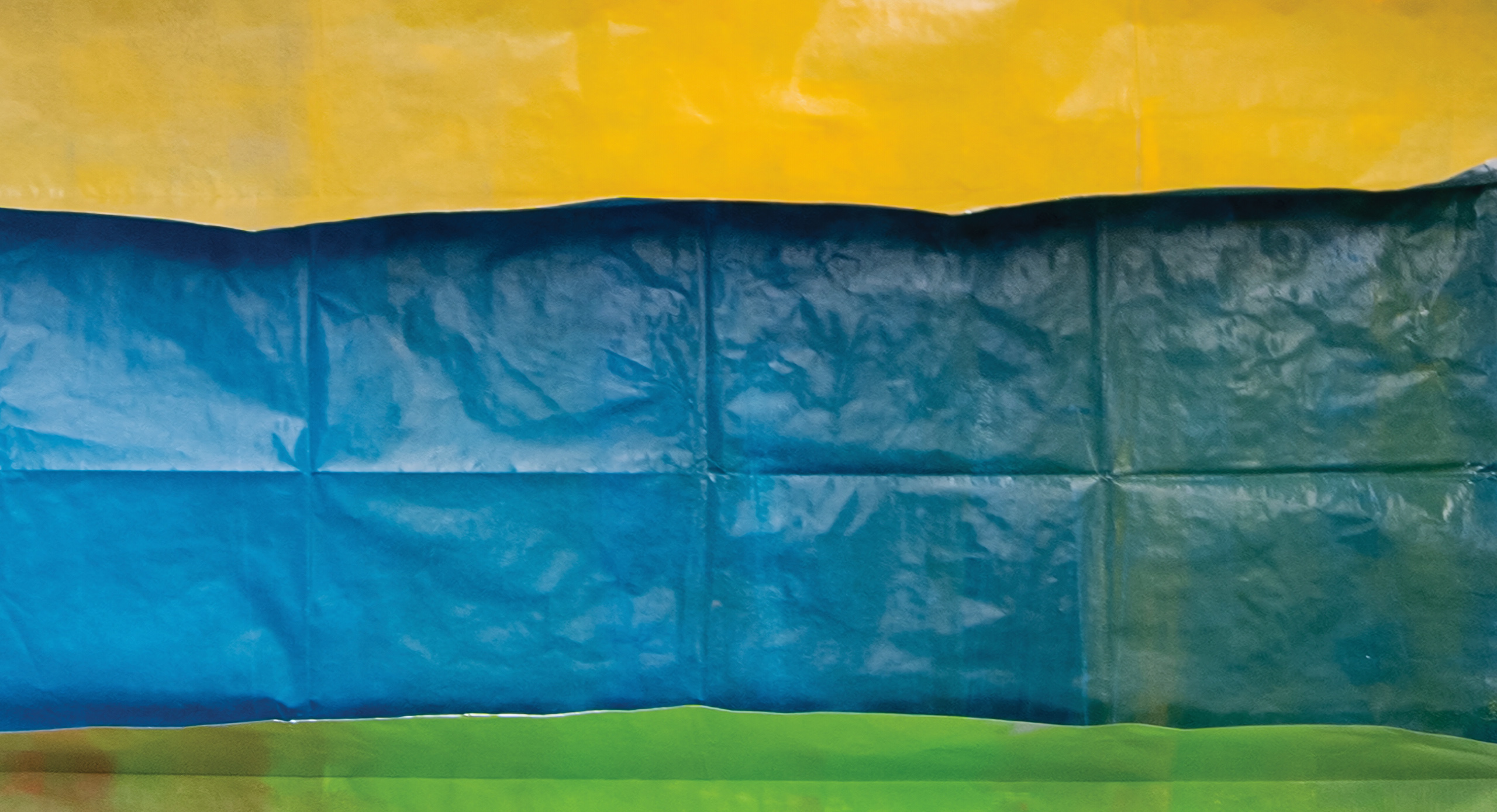
Maruša Sagadin’s (b.1978) practice is rooted in exploration of architectural history and built environments through humorous strategies and exaggeration. Her large-scale paper objects are made from used, overpainted advertising posters, glued, and reinforced with aluminum foil, still bearing signs of their previous function, storage, and transport. The textless color fields playfully obfuscate each poster’s informational role, drawing attention instead to recirculation, recycling, and impermanence. The series called Blinds, Blind Bees, Plan B references elements of the city—blinds, curtains, air conditioning units, railings, rain gutters, or fountains — recast as sculptural fragments of an urban vernacular.
Kristin Wenzel’s (b. 1983) practice unfolds through large-scale installations, sculptures, and interventions in public space, often conceived as site-specific and site-sensitive social environments. The two works on view are fragments of a larger installation, The Near and the Elsewhere, first shown in 2020 at Suprainfinit Gallery, Bucharest, where the exhibition space was transformed into an empty swimming pool — or rather, an imagined version of one, born from a childhood memory of a swimming pool in the GDR. Part sculpture, part space of possibility, the work explores cultural identity and participation alongside processes of transformation in public space. Conceived as site-specific, The Near and the Elsewhere continues to evolve, gradually transferred, in fragments, into new spatial contexts.
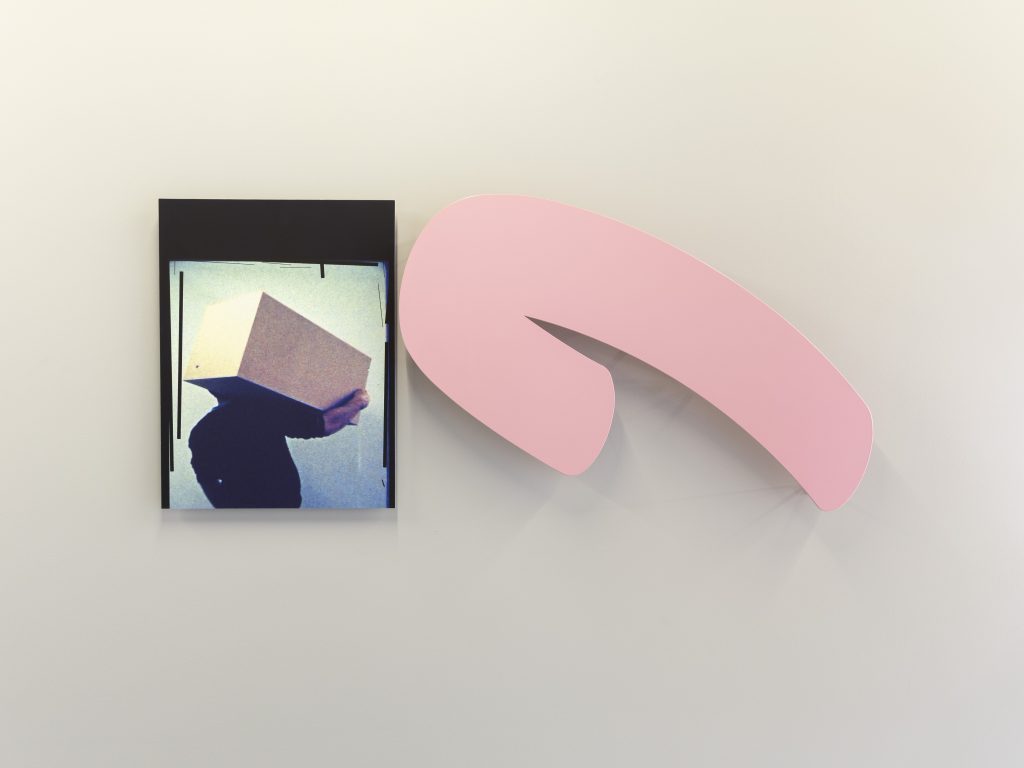
Mădălina Zaharia (b. 1985) explores ways of fictionalizing and instrumentalizing personal experience as a means of better understanding our relationship to the wider world — drawing on affect theory, experimental cinema, poetry, and writing as tools for collectively imagining social aspirations and future norms. Working from the Brechtian premise that a play is never reality itself but a representation of it, The Staging of an Exhibition II takes the form of a patterned, ever-fluid scenario in which white walls become lines, lines become objects, and objects become images adorning the white walls in turn. The work stands as a personal, affectionate description of the space and its habitual function — challenging its theatrical potential, and steadily replacing reality with imagination.
Courtesy of: Suprainfinit Gallery, Bucharest; Plan B, Cluj, Berlin, Ivan Gallery, Bucharest; Christine König Galerie, Vienna and artists.
3rd floor, MARe/Museum of Recent Art
Coordination Assistent: Maria Grigorescu | Producer: Cristi Tănase
—–
Images
Mădălina Zaharia_Înscenarea unei expoziții_2016_Courtesy Ivan Gallery
APPARATUS 22_Polyhappiness_2019_150 × 100 cm__Courtesy Suprainfinit Gallery
Adelina Ivan_Fără titlu_2026 (plasa bumbac)_2021–2025 (acrilic)_Courtesy of the artist
—-
key visual artwork: Maruša Sagadin (b. 1978, Ljubljana)
Photo: Simon Veres